Oura Deep Sleep Accuracy: What Sleep Lab Studies Show
The short answer
If you're a healthy adult wearing an Oura Ring Gen3, the best recent lab studies suggest its nightly deep sleep total comes close to what a sleep lab measures, on average. That last part matters. Group averages can hide big misses on single nights. Almost every study so far was also done in healthy people, and the newer ones were often funded or supported by Oura.
Here's what the research actually shows, and how to read your own number sensibly.
How a sleep lab measures deep sleep
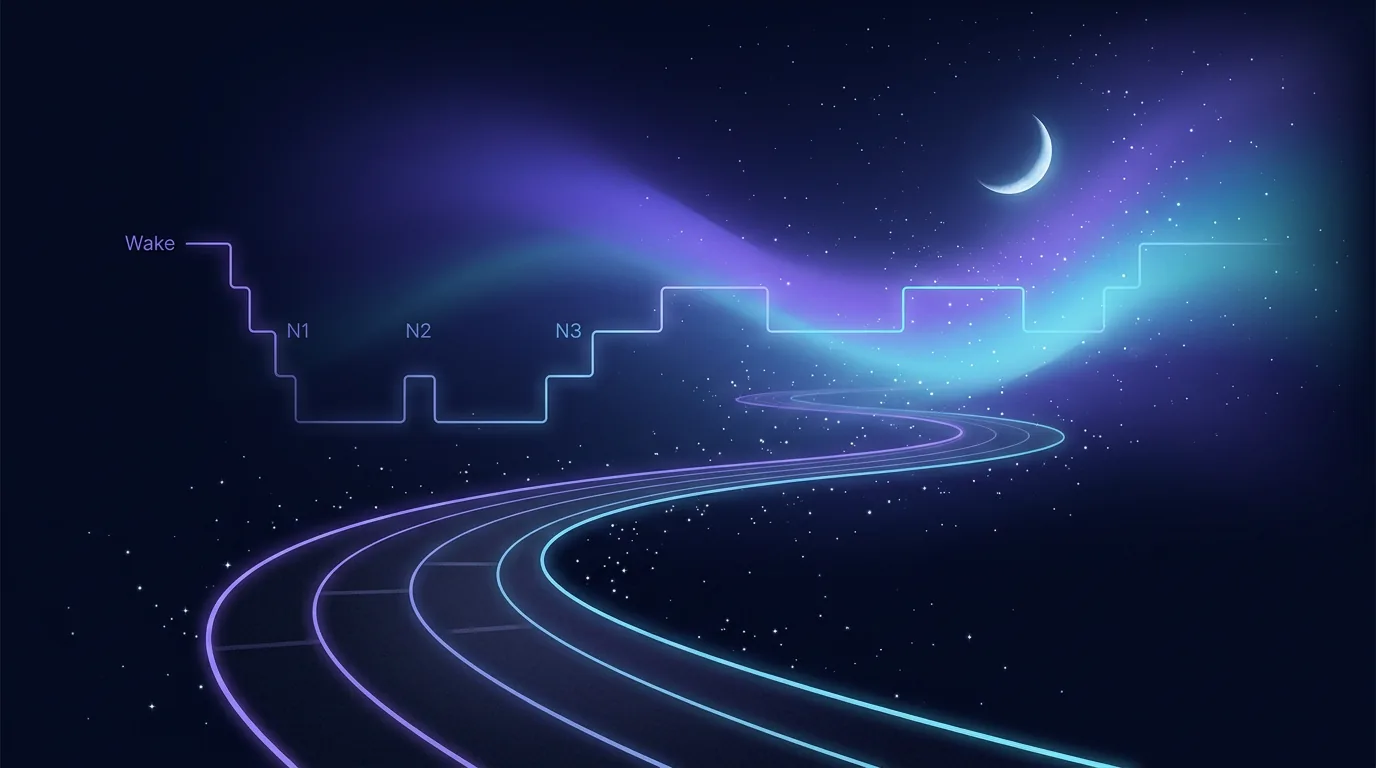
The reference standard is polysomnography (PSG). Electrodes on the scalp record brain waves, along with eye movements, muscle tone, breathing and heart rhythm. A trained technologist then goes through the night in 30 second chunks called epochs and gives each one a stage: wake, N1, N2, N3 or REM. Deep sleep is N3, which is defined by slow, high amplitude brain waves.
An Oura ring can't see brain waves. It works out your stages from what it can pick up at your finger: movement, heart rate, heart rate variability and skin temperature, plus the time of night. So the ring doesn't measure deep sleep directly. It estimates it, and validation studies check how close that estimate gets.
Even the gold standard wobbles
Before judging the ring, it helps to know how much human experts agree with each other. In the American Academy of Sleep Medicine's inter-scorer reliability program, more than 2,500 scorers rated the same 1,800 epochs. Rosenberg and Van Hout (2013) found that overall, scorers matched the majority score 82.6% of the time. For stage N3 it was just 67.4%.
That doesn't make PSG unreliable. It means deep sleep has a fuzzy edge even for trained people looking at brain waves. Keep that in mind when you judge any wearable against PSG, because the reference itself has some wobble in it.
What the validation studies found
These are the studies I read, starting with the newest hardware:
- Oura Gen3 vs home PSG, 96 adults. Svensson and colleagues (2024) studied 96 generally healthy Japanese adults aged 20 to 70, each with up to three nights of ambulatory PSG. Time in deep sleep didn't differ significantly from PSG, and the authors concluded that agreement was good for light and deep sleep. Stage by stage accuracy ranged from 75.5% for light sleep to 90.6% for REM. Three of the five authors reported financial support from Oura Health.
- Oura Gen3, Apple Watch and Fitbit vs lab PSG, 35 adults. Robbins and colleagues (2024) brought 35 healthy adults aged 20 to 50 into a hospital research unit for one night. Average deep sleep came out at 95 minutes on both the ring and PSG. The ring correctly labeled 79.5% of the epochs PSG scored as deep sleep, with a standard deviation of 14.5%, so some participants fared noticeably worse. Four stage agreement was a kappa of 0.65, which is usually read as substantial. In the same study, the Apple Watch Series 8 underestimated deep sleep by 43 minutes. Oura funded the research, and the first author sits on Oura's medical advisory board.
- Second generation Oura vs PSG, 53 adolescents. Chee and colleagues (2021) followed 53 Singaporean teenagers aged 15 to 19 over 15 days, with PSG on eight nights. The older ring overestimated N3 by 31.5 to 46.8 minutes, depending on how long they were allowed to sleep, and the authors wrote that its staging needed improvement. The ring still picked up the effects of the sleep changes, in line with PSG.
- Algorithm development data, 106 people. Altini and Kinnunen (2021) paired 440 nights of PSG from 106 people with data from the ring. Four stage accuracy was 57% using movement alone. It rose to 79% once heart rate variability, temperature and circadian features were added. That figure comes from cross validation within one dataset, so it isn't an independent test.
So how accurate is Oura deep sleep?
Putting it together: with current hardware and software, Oura's deep sleep total for a group of healthy adults looks close to PSG on average. Older versions were off by half an hour or more in teenagers. And a 79.5% epoch match means about one in five epochs that the lab called deep sleep got labeled as something else, even under good conditions.
For your own data, what matters is the size of a change. A swing of 10 or 15 minutes between two nights may well be noise. A shift that holds for a couple of weeks is more believable, because random errors tend to cancel out over many nights while real changes add up. That's a reasonable assumption, but none of the studies above tested it directly for individual users.
What the research can't tell you
These limits are real, and the authors say so themselves.
Who was studied. Participants were healthy, mostly young adults or teenagers without diagnosed sleep disorders. Robbins and colleagues note specifically that their sample didn't include people with insomnia. This work tells us very little about accuracy in older adults, in people with sleep apnea or insomnia, or in people taking medicines that change how they sleep.
Industry ties. Both Gen3 studies had Oura funding or authors supported by Oura. That doesn't make the results wrong, but fully independent replication would carry more weight.
One night in a lab. The Robbins study covered a single night in a hospital unit, and the authors acknowledge that may not reflect sleep at home. Svensson's team used home PSG across several nights, which helps.
Averages vs you. An average bias of zero can come from overestimating some people and underestimating others. None of these papers tells you how large the error is for you.
Software changes. Oura updates its algorithms. Results for one version don't automatically carry over to the next, and the 2021 findings in teenagers may not describe today's ring.
Not a diagnostic tool. The American Academy of Sleep Medicine's 2018 position statement says consumer sleep technology can't be used to diagnose or treat sleep disorders. It adds that these devices may help the conversation with a clinician as part of a proper evaluation.
How to use your deep sleep number well
Treat it as a trend line, not a lab report. Compare yourself with yourself over weeks, not with a friend or a chart of normal values. If you want to know whether a habit matters, change one thing at a time, because you can't separate the effects of two changes made together. And give it enough nights. That's the idea behind Somnia Deep Sleep, an iPhone app now in beta. It reads the sleep stages your Oura already writes to Apple Health and compares 14 nights of one habit change against your own 30 night baseline. Each result gets a label: Strong signal, Likely, or Too early to tell.
Some things a ring can't settle at all. See a doctor if someone notices loud snoring with gasping or pauses in your breathing, if trouble sleeping has gone on for more than three months, or if daytime sleepiness affects your driving. Those call for a proper clinical assessment, not a ring.
Sources
- Svensson T, Madhawa K, Nt H, Chung UI, Kishi Svensson A. Validity and reliability of the Oura Ring Generation 3 (Gen3) with Oura sleep staging algorithm 2.0 (OSSA 2.0) when compared to multi-night ambulatory polysomnography: A validation study of 96 participants and 421,045 epochs. Sleep Medicine. 2024;115:251-263. PubMed
- Robbins R, Weaver MD, Sullivan JP, et al. Accuracy of Three Commercial Wearable Devices for Sleep Tracking in Healthy Adults. Sensors. 2024;24(20):6532. PMC
- Chee NIYN, Ghorbani S, Golkashani HA, Leong RLF, Ong JL, Chee MWL. Multi-Night Validation of a Sleep Tracking Ring in Adolescents Compared with a Research Actigraph and Polysomnography. Nature and Science of Sleep. 2021;13:177-190. Dove Press
- Altini M, Kinnunen H. The Promise of Sleep: A Multi-Sensor Approach for Accurate Sleep Stage Detection Using the Oura Ring. Sensors. 2021;21(13):4302. MDPI
- Rosenberg RS, Van Hout S. The American Academy of Sleep Medicine inter-scorer reliability program: sleep stage scoring. Journal of Clinical Sleep Medicine. 2013;9(1):81-87. PubMed
- Khosla S, Deak MC, Gault D, et al; American Academy of Sleep Medicine Board of Directors. Consumer Sleep Technology: An American Academy of Sleep Medicine Position Statement. Journal of Clinical Sleep Medicine. 2018;14(5):877-880. AASM
Curious whether a habit really changes your deep sleep, rather than what a study average says? Join the Somnia beta and test it on your own nights.
This article is general information, not medical advice.
Test it on your own nights
Somnia runs 14-night habit experiments on the deep-sleep data your Apple Watch, Oura or Whoop already records, then tells you how confident the result is.
Join the beta