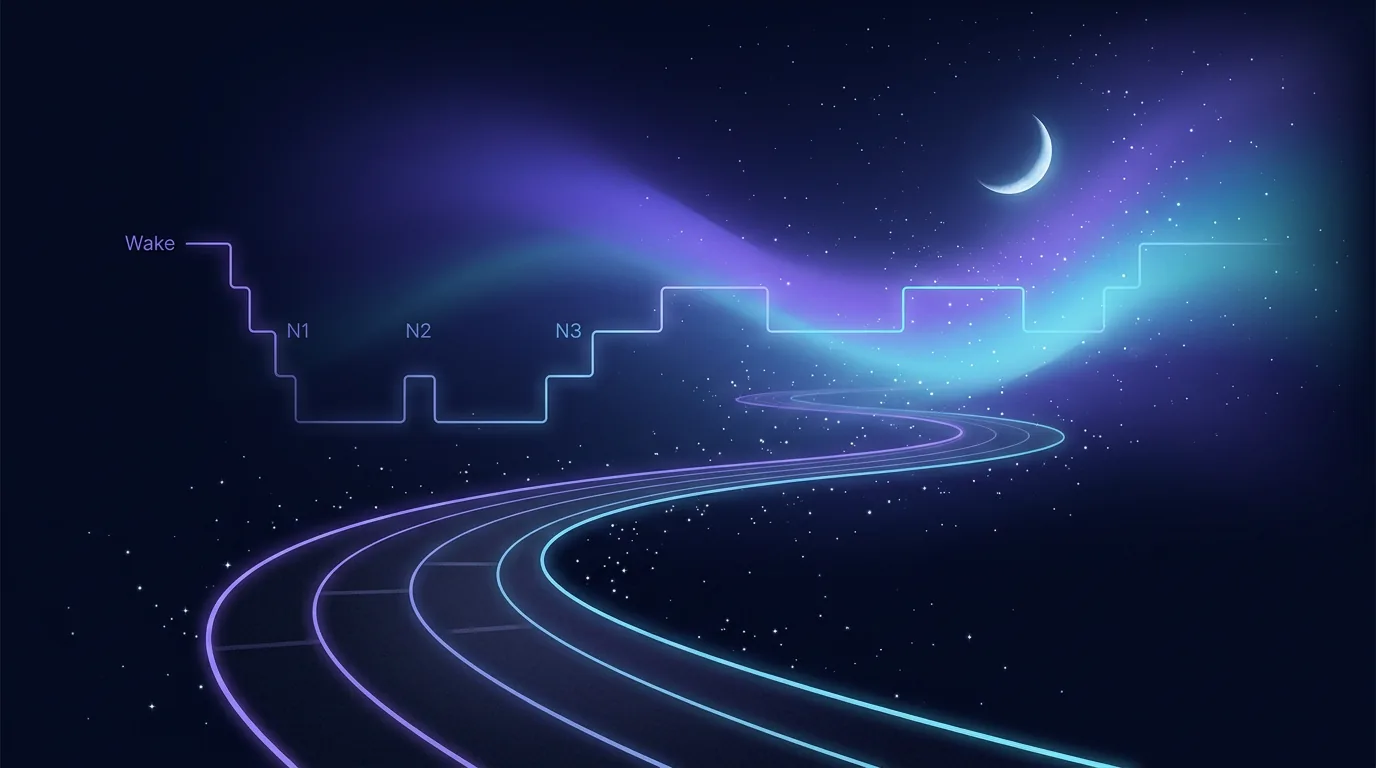
Eating Before Bed: What Late Dinners Do to Deep Sleep
You've probably heard the rule: stop eating three hours before bed. Maybe your watch has backed it up by showing a thin strip of deep sleep after a 10pm pasta dinner. So what does the research actually say about eating before bed and deep sleep?
Less than the rule suggests. And one of the better controlled studies points the other way.
Where the three hour rule comes from
Most of it comes from research on acid reflux, not on deep sleep. In a Japanese case control study, Fujiwara and colleagues compared 147 people with gastroesophageal reflux disease (GERD) against 294 matched people without it. Everyone reported their usual gap between dinner and bedtime on a questionnaire. After adjusting for smoking, drinking and body mass index, people who went to bed less than three hours after dinner had 7.45 times the odds of GERD compared with people who waited four hours or more.
That's a big association, but it's an association. The study can't show that the short gap caused the reflux. Still, it's the clearest reason to leave space after dinner: if heartburn wakes you up, it doesn't matter much what your deep sleep was doing before that.
The best controlled test: dinner at 10pm vs 6pm
The most careful test of meal timing and sleep stages comes from a Johns Hopkins lab. In a randomized crossover trial published in the Journal of Clinical Endocrinology & Metabolism, Gu and colleagues had 20 healthy adults, average age 26, eat the same dinner at either 6pm or 10pm on separate lab visits. Lights went out at 11pm, and sleep was measured with full polysomnography, the clinical standard that reads brain waves directly.
Sleep barely moved. After the late dinner, people slept 421 minutes vs 413 after the early one, and deep sleep (stage N3) made up 22.9% of the night vs 24.0%. Neither difference was statistically significant.
Metabolism did change. Blood sugar peaked about 18% higher after the late dinner (150 vs 127 mg/dL), and the body burned less of the dinner's fat overnight: 74.5% vs 84.5% of a fat tracer had been oxidized by the next morning.
The same team then reanalyzed the brain wave data in Nature and Science of Sleep. Looking at EEG power rather than stage labels, Duan and colleagues found the late dinner gave about 2.5% more delta activity, the slow brain waves that define deep sleep, early in the night. The effect faded as the night went on and reversed after roughly five hours, so sleep in the second half looked slightly lighter. Arousals didn't differ. The authors call this a post hoc analysis in a small sample, so it's a lead, not a conclusion.
A study where the later dinner looked better
In a 2023 crossover study in the International Journal of Sport Nutrition and Exercise Metabolism, Lehmann and colleagues had 12 adolescent rugby players, average age 15.8, eat dinner either 3.5 hours or 1.5 hours before bed for five days each. Sleep was measured by polysomnography. With the later dinner, the players slept 24 minutes longer, spent 25 fewer minutes awake during the night and reached deep sleep 6.9 minutes sooner. Total deep sleep didn't change.
These were hard training teenagers, who may simply have gone to bed hungry under the earlier schedule. You can't apply this to a desk working 45 year old. It does show that eating closer to bed isn't harmful for everyone by default.
What's on the plate may matter as much as the clock
Two studies point toward what you eat rather than when.
In a 2011 study in the Journal of Clinical Sleep Medicine, Crispim and colleagues followed 52 healthy adults aged 19 to 45, who kept three day food diaries and slept in a lab. More calories and fat at dinner and late snacks went with taking longer to fall asleep, lower sleep efficiency and more time awake after falling asleep, mostly in women. Late intake wasn't linked to the amount of deep sleep. Food diaries are imprecise, and this kind of correlation can't show cause.
In a 2016 inpatient study, also in the Journal of Clinical Sleep Medicine, St-Onge and colleagues studied 26 normal weight adults aged 30 to 45. After one day of choosing their own food, people got less deep sleep and took longer to fall asleep than after days on a controlled diet. More fiber went with more deep sleep. A bigger share of calories from saturated fat went with less deep sleep, and more sugar went with more arousals. That was one day and one night, analyzed after the fact.
Putting it together
Here's a fair reading of the evidence so far:
- In healthy young adults in a lab, dinner one hour before lights out didn't change total deep sleep.
- Late eating clearly shifts overnight blood sugar and fat burning, even when sleep looks the same.
- Reflux is the best supported reason to leave a gap of three hours or more, especially if you get heartburn.
- What you eat in the evening (fat, fiber, sugar, portion size) may matter as much as when, though that evidence comes from small, short studies.
- Going to bed hungry isn't automatically better, at least for very active teenagers.
Can your wearable even see the difference?
The effects in these lab studies are small, about one percentage point of N3 or a few percent of delta power. Consumer trackers aren't built to see changes that fine.
In a 2024 validation study in Sensors, Robbins and colleagues tested an Oura Ring Gen3, an Apple Watch Series 8 and a Fitbit Sense 2 against polysomnography in 35 healthy adults aged 20 to 50, each for a single night. On average the Apple Watch logged about 51 minutes of deep sleep when the lab measured 94, and it caught 50.5% of deep sleep epochs. The Oura caught 79.5% and showed no significant bias in any stage. Oura funded the study, and the lead author sits on Oura's medical advisory board. Whoop wasn't tested.
So one night's number can't tell you much. Your deep sleep also varies from night to night for reasons that have nothing to do with dinner. A more honest approach is to change one thing, keep it up for a couple of weeks, and compare against your own normal. That's how Somnia Deep Sleep, an iPhone app now in beta, works: you run a 14 night experiment on a habit like a late meal, and it compares the deep sleep your Apple Watch, Oura or Whoop already writes to Apple Health against your own 30 night baseline, then labels the result Strong signal, Likely or Too early to tell. Even then, your tracker's errors still apply. Comparing your own nights with each other assumes the device's bias stays roughly the same from night to night, and nobody has tested whether it shifts after a big meal.
What the research can't tell you
The trials here are small: 20, 12, 26 and 52 people. Most participants were young and healthy, and most of the sleep data came from one or a few nights in a lab, with fixed bedtimes and set meals. We don't have long term trials of meal timing and deep sleep. Older adults, shift workers and people with obesity, diabetes, reflux or sleep apnea are barely represented, and they're the people for whom timing might matter most. Real late dinners also tend to come with wine, bigger portions and later bedtimes, and lab studies separate those out on purpose. So the honest answer for any one person is: it depends, and the research can't yet say on what.
When to talk to a doctor
Some sleep problems aren't about dinner at all. See a doctor if you or a partner notice loud snoring with gasping or pauses in breathing, if you've had trouble sleeping most nights for more than three months, if daytime sleepiness affects your driving, or if heartburn regularly wakes you at night.
Sources
- Fujiwara Y, Machida A, Watanabe Y, et al. Association between dinner-to-bed time and gastro-esophageal reflux disease. American Journal of Gastroenterology. 2005;100(12):2633-2636. PubMed
- Gu C, Brereton N, Schweitzer A, et al. Metabolic Effects of Late Dinner in Healthy Volunteers: A Randomized Crossover Clinical Trial. Journal of Clinical Endocrinology & Metabolism. 2020;105(8):2789-2802. PMC
- Duan D, Gu C, Polotsky VY, Jun JC, Pham LV. Effects of Dinner Timing on Sleep Stage Distribution and EEG Power Spectrum in Healthy Volunteers. Nature and Science of Sleep. 2021;13:601-612. PMC
- Lehmann L, Saidi O, Giacomoni M, et al. A delayed evening meal enhances sleep quality in young rugby players. International Journal of Sport Nutrition and Exercise Metabolism. 2023;33(1):39-46. SPONET record
- Crispim CA, Zimberg IZ, dos Reis BG, et al. Relationship between Food Intake and Sleep Pattern in Healthy Individuals. Journal of Clinical Sleep Medicine. 2011;7(6):659-664. PMC
- St-Onge MP, Roberts A, Shechter A, Choudhury AR. Fiber and Saturated Fat Are Associated with Sleep Arousals and Slow Wave Sleep. Journal of Clinical Sleep Medicine. 2016;12(1):19-24. PMC
- Robbins R, Weaver MD, Sullivan JP, et al. Accuracy of Three Commercial Wearable Devices for Sleep Tracking in Healthy Adults. Sensors. 2024;24(20):6532. PMC
Curious whether late dinners change your own deep sleep? Join the Somnia beta and test the habit on your own nights.
This article is general information, not medical advice.
Test it on your own nights
Somnia runs 14-night habit experiments on the deep-sleep data your Apple Watch, Oura or Whoop already records, then tells you how confident the result is.
Join the beta