Why Your Deep Sleep Number Jumps Around Night to Night
Open your sleep app three mornings in a row and you might see 1 hour 20 minutes of deep sleep, then 48 minutes, then 1 hour 5. Nothing obvious changed. Same bed, same bedtime, roughly the same day. So which number is the real you?
None of them on its own. Deep sleep variability comes from two places at once. Your brain really does sleep a bit differently every night, and the device on your wrist or finger is estimating stages it can't see directly. Once you understand both, the jumps look a lot less alarming and become much more useful.
Deep sleep varies even in a sleep lab
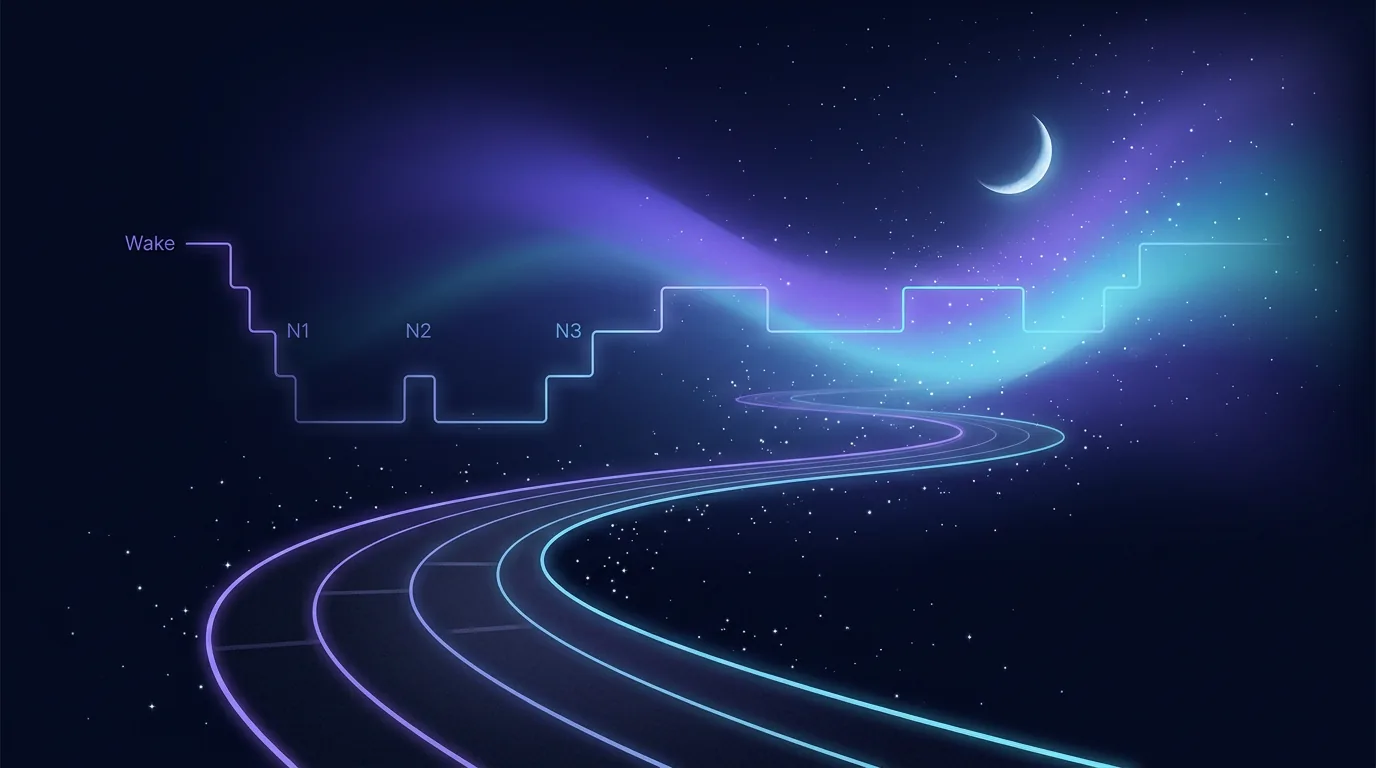
Deep sleep, which researchers call N3 or slow wave sleep, is defined by large, slow brain waves on an EEG. The gold standard for measuring it is polysomnography (PSG). Technicians attach electrodes to your scalp and score your night in 30 second chunks.
Even with all that equipment, the number moves. In a study published in 2024 in the Journal of Sleep Research, Mullins and colleagues recorded cognitively normal older adults for two nights in a row in the lab. Test-retest reliability for the percentage of slow wave sleep was only moderate, and the broad sleep architecture measures showed poor reproducibility overall. Slow wave activity, a finer EEG measure of how intense those waves are, held up better. The second night also ran longer, about 6.8 hours of sleep versus 6.3. That's a reminder that a strange room tends to spoil the first night.
Longer recordings look similar. A report in the Journal of Clinical Sleep Medicine followed one patient with mild to moderate sleep apnea through 28 consecutive nights of home PSG. Slow wave sleep and REM were among the measures that varied least. They still varied, though, and the authors found no significant link between one night and the next, or between a night and the same weekday a week later. One person proves nothing general. It does show what a month of gold standard data can look like: wobble with no obvious rhythm.
Your tracker adds its own noise
Apple Watch, Oura and Whoop don't read brain waves. They infer stages from signals like movement and heart rate, then run those through proprietary algorithms. That's a reasonable approach, but it means some of the swing you see on screen is estimation error, not biology.
The most useful recent head to head test I found is Robbins and colleagues in Sensors (2024). Thirty five healthy adults aged 20 to 50 spent one night in a hospital sleep lab wearing an Oura Ring Gen3, a Fitbit Sense 2 and an Apple Watch Series 8, all while hooked up to PSG. Of the 30 second chunks that PSG scored as deep sleep, the Oura ring correctly caught 79.5%, the Fitbit 61.7% and the Apple Watch 50.5%. On average the Apple Watch reported about 51 minutes of deep sleep against roughly 94 on PSG, an underestimate of around 43 minutes. Oura's average matched PSG. Those are group averages, and the spread was wide, so any single night's reading could be off in either direction.
Two caveats. Oura funded the study and the lead author sits on Oura's medical advisory board, both disclosed in the paper. And it covered a single night with healthy younger adults, so it can't tell you how a device performs over weeks in your own bedroom. I didn't find a comparable peer reviewed PSG study of Whoop that I could read in full, so I won't put a number on it.
The American Academy of Sleep Medicine's position statement on consumer sleep technology makes the wider point. These devices can't be used to diagnose or treat sleep disorders, but their data can help start a conversation with a clinician.
What really shifts deep sleep from night to night
Set measurement error aside and there are still real influences on slow wave sleep:
- Sleep pressure. Slow wave activity tracks how long you've been awake. Dijk's 2009 review in the Journal of Clinical Sleep Medicine shows it rebounding in recovery sleep after 36 hours of sleep deprivation and declining over the course of each sleep episode. Deep sleep is front loaded, so a broken first few hours can cost more of it than a restless final hour.
- Alcohol. A review of studies in healthy volunteers by Ebrahim and colleagues (2013) found that alcohol generally increases slow wave sleep in the first half of the night, while the second half gets more disrupted. So a drink can push your deep sleep number up while making the night worse overall. Later letters to the journal disputed the review's methods, which is worth knowing.
- Age. A meta-analysis of 65 PSG studies covering 3,577 healthy people aged 5 to 102 found that the percentage of slow wave sleep falls with age in adults (Ohayon and colleagues, SLEEP, 2004). That's a slow drift over years, not nightly noise, but it's why comparing your number with a friend's says very little.
- New surroundings. The longer second night in the Mullins lab study is a small hint that hotels, travel and unfamiliar beds can reshape a night.
How to read a number that won't sit still
Look at averages over a week or more, not single nights. With only moderate night to night reliability even in a sleep lab, one or two nights of wearable data can't tell you much.
Compare yourself with yourself. Age and device differences make population averages a poor yardstick. Stick with one device, too. The Robbins study found the three devices disagreed with each other in consistent ways, so switching from a ring to a watch can move your number with no change in your sleep.
If you want to test a habit, change one thing and give it enough nights to rise above the noise. That's the idea behind Somnia Deep Sleep, an iPhone app now in beta. It reads the sleep stages your Apple Watch, Oura or Whoop already writes to Apple Health, compares 14 nights of a single habit change with your own 30 night baseline, and labels the result Strong signal, Likely or Too early to tell.
Finally, don't chase the number for its own sake. The alcohol research shows a higher deep sleep reading isn't automatically a better night.
What the research can't tell you
The validation evidence is thin. The best recent study tested one night, 35 people and specific device models, and companies update their algorithms over time. Results for an older watch or a newer ring may differ.
The reliability studies used PSG, not wearables, and mostly looked at small or specific groups: older adults over two lab nights, or a single patient over a month. Nobody has firmly established how much nightly swing is normal for a typical wearable user at home.
It's also not established that nudging your tracker's deep sleep figure up or down changes your health. Lab findings on alcohol or sleep deprivation describe groups under controlled conditions and may not carry over to your own everyday life. Even a careful personal experiment can be thrown off by stress, illness or the season.
When to see a doctor
A jumpy deep sleep number on its own isn't a reason to worry. Talk to a doctor if you or a bed partner notice loud snoring with gasping or choking, if trouble falling or staying asleep has lasted more than three months, or if daytime sleepiness affects your driving or your safety at work. Bring your tracker data if you like, but expect a proper evaluation, not a diagnosis from the app.
Sources
- Mullins AE, Pehel S, Parekh A, Kam K, Bubu OM, Tolbert TM, Rapoport DM, Ayappa I, Varga AW, Osorio RS. The stability of slow-wave sleep and EEG oscillations across two consecutive nights of laboratory polysomnography in cognitively normal older adults. Journal of Sleep Research. 2025;34(1):e14281 (online 2024). PubMed
- Fietze I, Glos M, Zimmermann S, Penzel T. Long-term variability of the apnea-hypopnea index in a patient with mild to moderate obstructive sleep apnea. Journal of Clinical Sleep Medicine. 2020;16(2):319-323. PMC
- Robbins R, et al. Accuracy of Three Commercial Wearable Devices for Sleep Tracking in Healthy Adults. Sensors. 2024;24(20):6532. PMC
- Khosla S, Deak MC, Gault D, et al.; American Academy of Sleep Medicine Board of Directors. Consumer Sleep Technology: An American Academy of Sleep Medicine Position Statement. Journal of Clinical Sleep Medicine. 2018;14(5):877-880. PMC
- Dijk DJ. Regulation and functional correlates of slow wave sleep. Journal of Clinical Sleep Medicine. 2009;5(2 Suppl):S6-S15. PubMed
- Ebrahim IO, Shapiro CM, Williams AJ, Fenwick PB. Alcohol and sleep I: effects on normal sleep. Alcoholism: Clinical and Experimental Research. 2013;37(4):539-549. PubMed
- Ohayon MM, Carskadon MA, Guilleminault C, Vitiello MV. Meta-analysis of quantitative sleep parameters from childhood to old age in healthy individuals: developing normative sleep values across the human lifespan. Sleep. 2004;27(7):1255-1273. PubMed
Curious whether that evening glass of wine or late workout really changes your deep sleep? Join the Somnia beta and test it on your own nights.
This article is general information, not medical advice.
Test it on your own nights
Somnia runs 14-night habit experiments on the deep-sleep data your Apple Watch, Oura or Whoop already records, then tells you how confident the result is.
Join the beta