Caffeine and Sleep: Does Late Coffee Cut Deep Sleep?
Most of us have heard the rule: no coffee after 2pm. It sounds like folk wisdom, but it sits closer to the research than you might expect. If you wear a sleep tracker, the more useful question is narrower. What does a late coffee do to your deep sleep, and could you actually see the effect in your own data?
Here's what the studies show, where they disagree, and where they run out.
How caffeine gets in the way of deep sleep
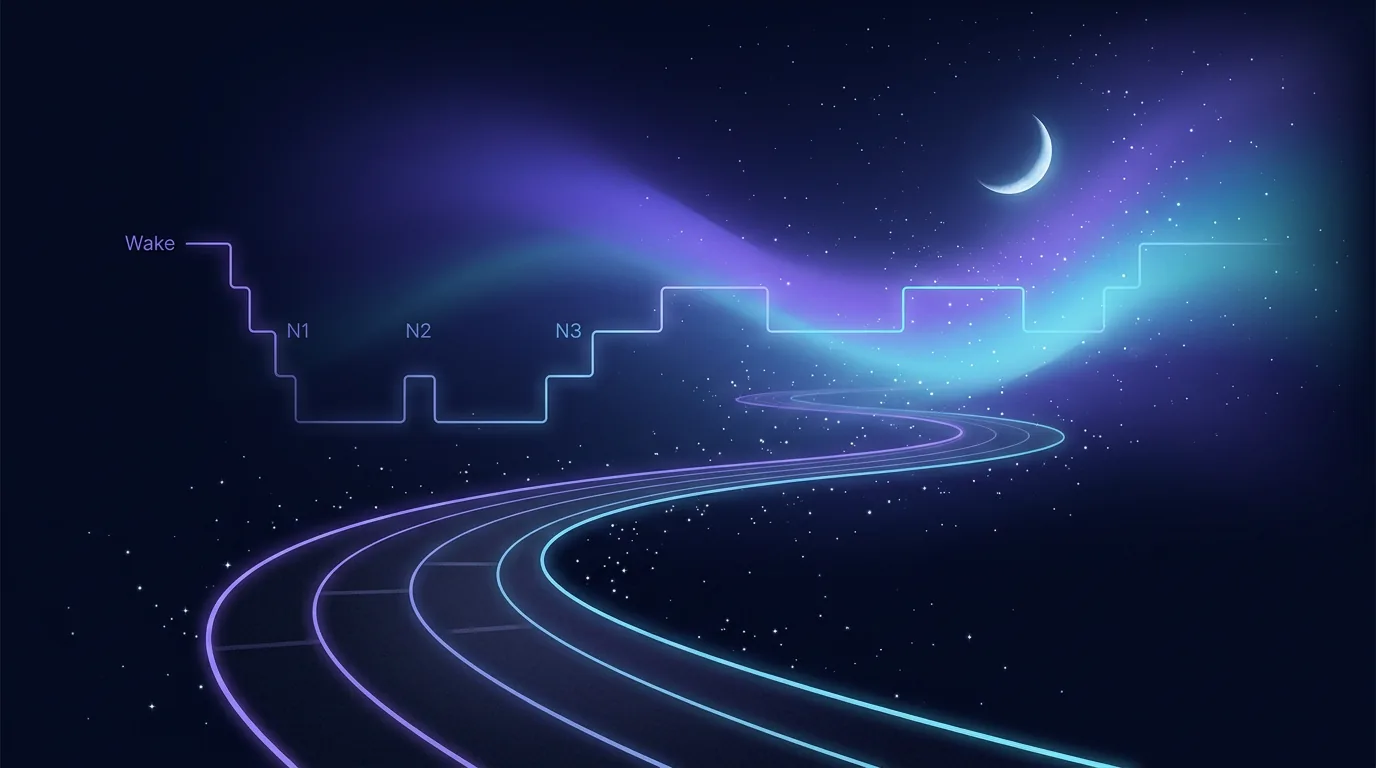
Through the day a molecule called adenosine builds up in the brain, and that buildup is part of why you feel sleepy by evening. Caffeine blocks adenosine receptors. That's why it works at 8am, and it's also why researchers have long suspected it interferes with deep sleep. Deep sleep is the slow wave stage, scored as N3 today, and it tends to cluster in the first part of the night.
One classic test came from a Zurich team in 1995. Landolt and colleagues gave eight young men either 100 mg of caffeine or a placebo at bedtime and recorded their sleep with polysomnography, the lab standard that uses EEG, eye and muscle sensors. For scale, the FDA puts a 12 ounce cup of regular brewed coffee at roughly 113 to 247 mg, so this was a modest dose. Caffeine still lengthened the time it took to fall asleep, lowered sleep efficiency and cut stage 4 sleep, the deepest part of what's now grouped as N3. Slow wave activity dropped, mostly in the first sleep cycle. The authors concluded that even a low dose affects the sleep EEG.
Eight people is a tiny sample, though, and caffeine right at bedtime is an extreme case. What matters for most of us is how long the effect lingers.
Six hours before bed still mattered
A 2013 study in the Journal of Clinical Sleep Medicine by Drake and colleagues tested timing directly. Participants took 400 mg of caffeine or a placebo at bedtime, three hours before bed or six hours before, then slept at home. Sleep was tracked with diaries and a validated portable sleep monitor. All three caffeine timings disturbed sleep compared with placebo, the six hour one included, and the authors said the loss of total sleep at six hours was big enough to matter. Their advice was to avoid substantial caffeine for at least six hours before bed.
Two caveats apply. First, 400 mg in one go is a lot; it's the same figure the FDA cites as a whole day's intake not generally linked to negative effects in healthy adults. Second, this study looked at overall sleep disruption and total sleep, not deep sleep in particular.
The big picture: about 11 minutes less deep sleep
The broadest view comes from a 2023 systematic review and meta-analysis in Sleep Medicine Reviews by Gardiner and colleagues, which pooled 24 studies. On average, caffeine:
- cut total sleep time by about 45 minutes
- added about 9 minutes to the time it took to fall asleep
- lowered sleep efficiency by 7%
- added about 12 minutes of waking after first falling asleep
- reduced deep (slow wave) sleep by about 11.4 minutes, or 1.4% of the night
- added about 6 minutes of light N1 sleep
So caffeine tips the night toward lighter sleep. On average the deep sleep loss is real but modest. The bigger costs are to total sleep and to staying asleep.
The authors also estimated how long before bed caffeine should come to avoid losing total sleep. For a standard coffee, which they put at 107 mg per 250 mL, the answer was at least 8.8 hours. For a typical pre-workout serving of 217.5 mg, it was 13.2 hours. If you go to bed at 11pm, 8.8 hours earlier is just after 2pm. The old rule holds up surprisingly well.
Regular coffee drinkers may be a different story
Now the counterweight. Weibel and colleagues studied 20 young men who already drank caffeine regularly. For ten days each man took 150 mg three times a day, a placebo, or caffeine with a switch to placebo near the end. The last daily dose came about eight hours after waking, and lights out came eight hours after that. On polysomnography, total sleep, time to fall asleep and sleep architecture, which includes deep sleep, didn't differ between conditions. The one change was lower power in a single EEG frequency band, and the authors suggested it might be an early sign of overnight withdrawal.
Their conclusion: morning and afternoon caffeine doesn't strongly impair sleep structure at night in healthy good sleepers who are used to it. That fits the 2pm idea rather than contradicting it, since their last dose came well before bed. But these were 20 young men, all sleeping well, so the study says little about women, older adults or anyone who already sleeps badly.
Why your result may differ from the average
The FDA notes that people vary widely in how sensitive they are to caffeine and how quickly they clear it, and that body weight, medications and some medical conditions change how much is too much. Pooled averages hide that spread. One person's 3pm latte may barely register. For someone else, it could quietly shorten that first cycle of deep sleep.
Can your wearable even see it?
This is the tricky part. Consumer trackers estimate sleep stages from movement and heart signals, not brain waves. In a 2024 study in Sensors, Robbins and colleagues compared the Oura Ring Gen3, Apple Watch Series 8 and Fitbit Sense 2 with polysomnography in 35 healthy adults over a single lab night. Oura's deep sleep estimate wasn't significantly different from the lab measurement. Apple Watch underestimated deep sleep by about 43 minutes on average. Whoop wasn't tested, so this study tells us nothing about it.
Compare that with the meta-analysis: an average deep sleep loss of about 11 minutes. For some devices, that signal is smaller than the measurement error. Comparing your device with itself helps, because a steady bias largely cancels out when you look at changes. But night to night noise doesn't go away. One rough night after a 4pm espresso tells you almost nothing. Two weeks of nights, set against a solid baseline, start to tell you something.
That's the idea behind Somnia Deep Sleep, an iPhone app in beta that reads the sleep stages your Apple Watch, Oura or Whoop already writes to Apple Health. You run a 14-night experiment, such as no caffeine after 2pm. The app then compares your deep sleep with your own 30 night baseline and labels the result Strong signal, Likely or Too early to tell.
What the research can't tell you
The deep sleep evidence rests on small studies. Landolt had eight participants and Weibel had 20, all young men. Lab studies use fixed capsule doses at set times, which isn't how anyone drinks coffee, and lab nights aren't home nights.
The meta-analysis averages across very different doses, timings and populations. Its 8.8 hour figure is about protecting total sleep, not deep sleep specifically. The wearable study covered one night in healthy adults, so we don't know how well those results hold for people with disrupted sleep or across months of real life.
No study here shows whether losing ten or so minutes of deep sleep on a given night has any lasting effect on your health. These studies measure sleep, not long term outcomes.
When to talk to a doctor
Cutting late caffeine is a reasonable experiment, but it isn't a treatment. See a doctor if you or a partner notice loud snoring with gasping or choking, if insomnia has bothered you most nights for more than three months, or if daytime sleepiness affects your driving or your work. If you're pregnant, breastfeeding, or take medication, the FDA suggests asking a health care provider what caffeine limit is right for you.
Sources
- Landolt HP, Dijk DJ, Gaus SE, Borbély AA. Caffeine reduces low-frequency delta activity in the human sleep EEG. Neuropsychopharmacology. 1995;12(3):229-238. PubMed
- Drake C, Roehrs T, Shambroom J, Roth T. Caffeine effects on sleep taken 0, 3, or 6 hours before going to bed. Journal of Clinical Sleep Medicine. 2013;9(11):1195-1200. PubMed
- Gardiner C, Weakley J, Burke LM, Roach GD, Sargent C, Maniar N, Townshend A, Halson SL. The effect of caffeine on subsequent sleep: a systematic review and meta-analysis. Sleep Medicine Reviews. 2023;69:101764. PubMed
- Weibel J, Lin YS, Landolt HP, Kistler J, Rehm S, Rentsch KM, Slawik H, Borgwardt S, Cajochen C, Reichert CF. The impact of daily caffeine intake on nighttime sleep in young adult men. Scientific Reports. 2021;11(1):4668. PubMed
- Robbins R, Weaver MD, Sullivan JP, Quan SF, Gilmore K, Shaw S, Benz A, Qadri S, Barger LK, Czeisler CA, Duffy JF. Accuracy of three commercial wearable devices for sleep tracking in healthy adults. Sensors (Basel). 2024;24(20):6532. PubMed
- U.S. Food and Drug Administration. Spilling the Beans: How Much Caffeine Is Too Much? Consumer Update. FDA
Curious whether your afternoon coffee changes your own deep sleep? Join the Somnia beta and run the experiment on your own nights.
This article is general information, not medical advice.
Test it on your own nights
Somnia runs 14-night habit experiments on the deep-sleep data your Apple Watch, Oura or Whoop already records, then tells you how confident the result is.
Join the beta